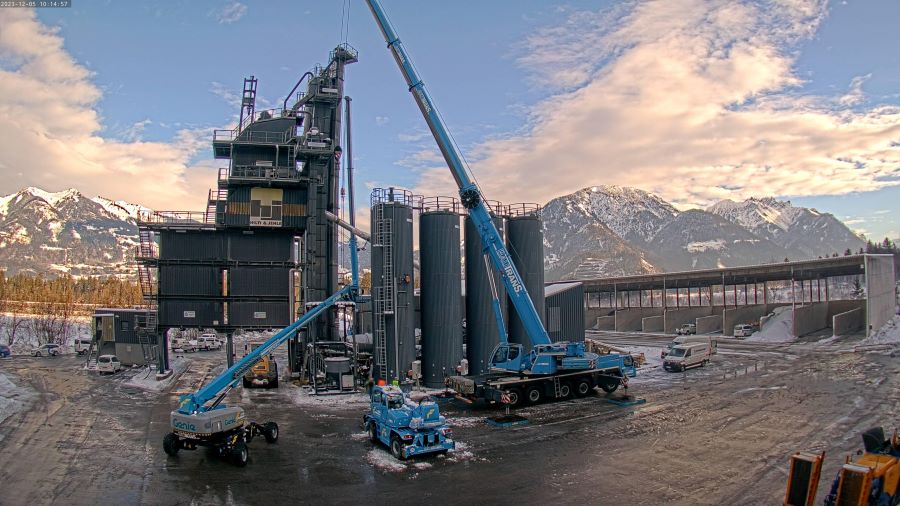
Reconfiguring, combining and expanding two asphalt mixing plants
At the Austrian sites of Götzis and Nenzing, there are two Benninghoven asphalt mixing plants that have already seen many years of use. They have now been modernized and combined into a new plant in Götzis.
In the Austrian town of Götzis, Benninghoven has built a high-performance asphalt mixing plant by combining two existing plants and upgrading them to the current state of the art. This Retrofit solution was feasible thanks to the modular design and extensive planning. The project took a sustainable approach: Thanks to the modular Benninghoven design, it was possible to reuse most of the components of the existing plants and combine them with new, innovative Retrofit solutions.
Dismantling, relocating and assembling the asphalt mixing plant
The TBA plant from Nenzing was dismantled and transported 21 kilometers to Götzis, where it was connected to the existing bitumen tanks.
TBA asphalt mixing plants feature a modular design and large storage capacities for the hot bin section and the mixed material loading silo. Suitable for both semi-mobile and stationary use, their outstanding flexibility, the large number of available options, and other specifications make TBA plants a true specialist when it comes to asphalt mixing plants. The innovative plant concept makes it possible to integrate the plant seamlessly throughout its life cycle.
More variety – more flexibility
Following the targeted expansion of the hot bin section at the Götzis plant, there are now 14 bins plus a rotary chute with a 150-t capacity. This means multiple types of aggregate can be stockpiled hot in the future. This has been supplemented by a combined bitumen supply system with an intelligent control system.
By combining the bitumen supply systems from both plants and integrating an intelligent bitumen control system, the customer can act flexibly to respond to short-term energy bottlenecks and fluctuating bitumen prices. This makes it possible to efficiently manage the volume as well as the variety of bitumen.
Higher ratio of RAP, easier to operate
Alongside the existing cold RAP system, the plant has also been pre-configured for hot gas generator technology with RAP ratios of up to 100%. This technology can further increase the proportion of RAP in the final product while simultaneously reducing the emissions released when producing asphalt mixtures.
For employees, the new BLS4 control system provides a clearer picture of the plant and makes it easier to operate. The plant’s storage capacities have also been expanded. There are now eight bins available for larger inbound storage capacities and more types of finished asphalt, as well as for storing mastic asphalt.
Strategic location comes with advantages for logistics
The newly installed plant is located at the southern tip of Lake Constance where no fewer than four nations share a border: Austria, Germany, Lichtenstein, and Switzerland. This means that asphalt mixtures can quickly be delivered between these countries. Multiple countries also means different requirements for the mixtures and a greater number of different recipes – all of which are easily achievable with the modernized plant.
Retrofit as expert solution
Asphalt mixing plant specialist Benninghoven designs its transportable plants not only to ensure they can be moved from one location to another. The modular design also means that existing plants are especially easy to retrofit with state-of-the-art components. Customers such as Hilti & Jehle focus on longstanding cooperation with a view to efficiency, sustainability and future-proofing. A project as complex as the one in Austria can only succeed with a strong team. Defining interfaces, understanding and taking account of process technology, and integrating into the control system – it is about so much more than simply swapping out a few steel parts.

















Partener Principal
MATEK Build Smart