Six Machines from Vögele Resurface the Automotodrom Brno with Special Asphalt Produced by a Benninghoven Asphalt Mixing Plant
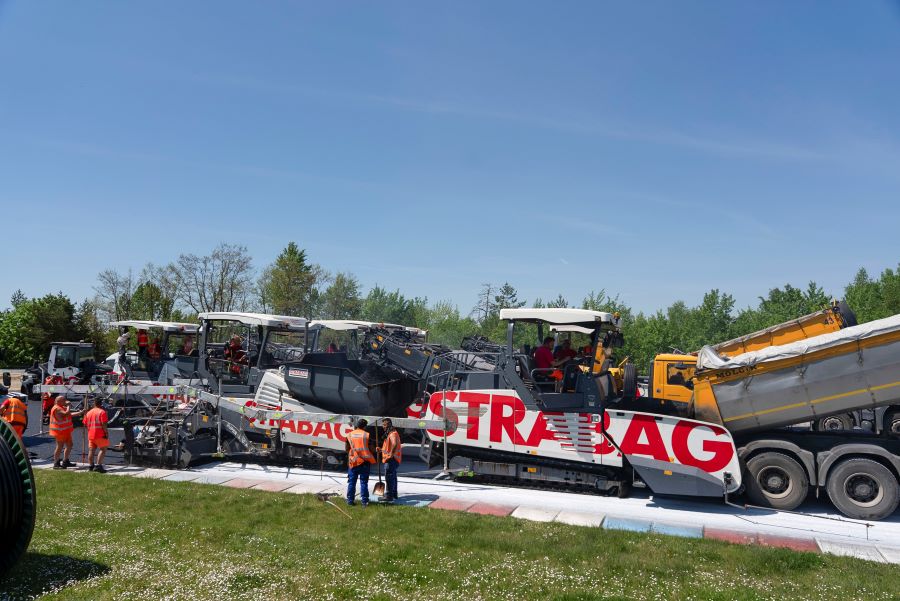
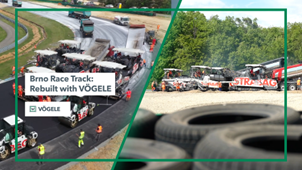
The project deadline specified the completion of the complete resurfacing of the 5.4 km Masaryk Circuit in the Czech Republic in only four weeks. In order to ensure an ideal track surface, the lead contractor used a special asphalt mix supplied by a Benninghoven asphalt mixing plant. Three road pavers and three material feeders from Vögele paved the leveling course and the asphalt surface course hot-to-hot.
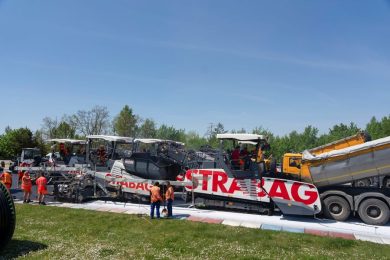
International racetracks have particularly stringent requirements with regard to evenness, grip, homogeneous texture, and other factors. The aim is to ensure maximum grip and consistent evenness of the surface and thus guarantee the safety of riders. The rehabilitation of the 5.4 km Masaryk Circuit in Brno involved the resurfacing of the entire racetrack: three Vögele SUPER 1800-3i pavers and three MT 3000-2i Standard material feeders paved a 2.5 cm leveling course and a 4 cm asphalt surface course across the entire track width of 15 to 17 m.
Challenging Requirements and a Tight Deadline
Apart from the precise specifications for both the asphalt mix and the paving process, the paving team managed by David Tejkal, Construction Manager at general contractor Strabag a.s., faced another challenge: “We had a strict deadline: the track had to be handed over two months before the Grand Prix.” This meant a very short preparation period of just four weeks. It was also only possible to work during the day, so a team of 50 workers and five engineers had to be on the site every day. “The tight schedule demanded precise coordination between everyone involved – as well as absolutely reliable, high-performance machine technology,” says Tejkal.
Special Asphalt Mix
The first step was to find the perfect material mix for the asphalt required to deliver an ideal track surface that would ensure better grip, allow higher speeds and provide greater safety. “Among other things, we defined and agreed upon project-specific specifications for all raw materials, the asphalt mix formula, processes and quality assurance measures with the FIM, (Fédération Internationale de Motocyclisme (International Motorcycling Federation) and monitored their implementation on the project site,” explains Mario Peiker, Managing Director and Technical Director of Hart Consult International GmbH. Any deviation from these specifications would potentially impact performance and safety. The special asphalt was produced in a Benninghoven BA 4000 asphalt mixing plant from Brnenska Obalovna / Strabag.
Self-Learning Smart Weighing System
The Smart Weighing System from Benninghoven, a state-of-the-art, smart dosing technology, proved ideal for this project. It has no sensors and trains itself to dose with maximum efficiency and minimal tolerances – even under varying conditions such as fluctuating temperatures or differing proportions of virgin material. The system reacts to the flow of material in real time, creating the conditions for managing the formula precisely – something that would be almost impossible to realize using conventional methods. This makes the Smart Weighing System an especially valuable asset wherever extremely tight formula tolerances are required – such as in this project, where any deviation from the specifications would have an impact on performance and safety. In order to be able to use the system, the first step was the integration of the latest version of the BLS 4 mixing plant control system from Benninghoven in the existing BA 4000 plant.
Vögele Material Feeders Ensure a Consistently Even Material Flow
The special asphalt had to be paved without interruptions and without any loss of temperature in order to satisfy the stringent quality requirements. This was ensured by precisely harmonized logistics: Thermally-insulated trucks delivered the asphalt mix directly to three Vögele MT 3000‑2i Standard material feeders. They took on the load in the shortest possible time and continuously conveyed material to the Vögele pavers. In this process, the sensor-controlled conveyor belt heating of the material feeders ensured that the asphalt arrived at the pavers without any heat loss.
Seamless Paving with Three Vögele Pavers
Paving itself was realized by the hot-to-hot method to achieve a seamless surface. The high shear forces on the racetrack during racing would otherwise very soon force open any seams or joints. The three SUPER 1800‑3i road pavers worked in parallel in a slightly staggered formation, paving strip to strip across the full track width of 15 to 17 m. Hot-to-hot paving ensured optimum bonding and a water-impermeable, stable and durable track surface.
Sensor System Ensures Maximum Evenness
To ensure precise adherence to the required longitudinal evenness, the paving team used the Vögele automated grade and slope control system in combination with the Big MultiPlex Ski. Three multi-cell sonic sensors mounted on the bracket system scanned the sub-base of the leveling course and the surface layer at several points simultaneously. The automated grade and slope control system used these measurements to calculate a mean value over the entire measuring range, and was thus able to compensate for unevenness, even in the case of elongated irregularities. The AB 500 TV extending screed and the tamper bar and vibration compacting systems ensured a high degree of pre-compaction that led to the realization of particularly high surface quality.
Paved, Tested, and Approved on Time
Despite the challenging time frame, the project was completed on schedule. In just four weeks, a total of around 14,000 t of asphalt mix was paved at the Automotodrom Brno circuit. Motorsport fans can now look forward to the return of an exciting program of spectacular racing events to Brno. www.wirtgen-group.com
Click here to view the video
You can find more videos on the Wirtgen Group YouTube Channel



























Partener Principal
MATEK Build Smart