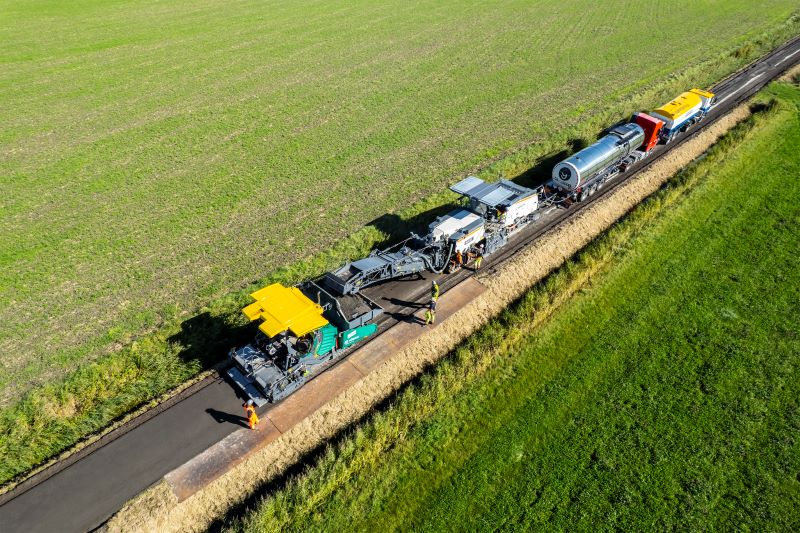
In-place cold recycling with Wirtgen Group machines
The project was to renew the agricultural road near the Dutch village of Ferwert quickly and economically using low-emission machinery. The contractors consequently decided to use the in-place cold recycling method, as this prepares the reclaimed material on site immediately and then reuses it for the paving process. They used a tried and tested combination of Wirtgen Group machines: the W 240 CRi cold recycler from Wirtgen and the new SUPER 2100-5i Highway Class paver from Vögele.
Saving CO₂ and money
The environmental performance of road construction projects is becoming more and more of a focus. In-place cold recycling has become established as a resource-saving technique which also delivers economic benefits as a result of the time and expense saved. The Dutch companies KWS and Freesmij opted for this rehabilitation method on the 1.3 km (0.8 mile) long and 3.10 meter (10.2 ft.) wide asphalt road near the village of Ferwert. The paving crew used the Wirtgen Group cold recycling train to mill off the existing asphalt layer and also to prepare the material on site (also called “in situ” or “in-place”) and make a new base course of bitumen-stabilized material (BSM) by mixing in binders and other aggregates. “In-place cold recycling is the response to the ecological and economic demands of modern road construction,” says Raymond van de Stadt, Managing Director Asphalt at primary contractor KWS. “In just two days, we renewed the entire stretch of road using 100% recycled material, thereby significantly reducing CO₂ emissions and, of course, saving time and costs compared to conventional methods.”
Powerful cold recycling train
Another benefit of cold recycling was key in this application on a narrow agricultural road: the entire recycling train takes up the width of just one lane. To rehabilitate the 3.10 meter (10.2 ft.) wide road in one pass, the team first used a W 100 Fi compact milling machine from Wirtgen to pre-mill at a width of 1.00 meters (3 ft.) and a depth of 15 cm (5.9 in.). This was followed by the cold recycling train, consisting of water and bitumen tank wagons, the Wirtgen W 240 CRi cold recycler and the new SUPER 2100-5i large paver from Vögele. As this process prepares the reclaimed material in situ and uses it for the paving process immediately, both the recycler and the paver had to achieve a high output. The W 240 CRi can produce up to 800 metric tonnes (882 tons) of material an hour at a maximum pave width of 2.35 meters (7.7 ft.), while the SUPER 2100-5i can take up to 20 metric tonnes (22 tons) of material with an extra material hopper and pave up to 1,100 metric tonnes (1,213 tons) per hour.
Efficient teamwork
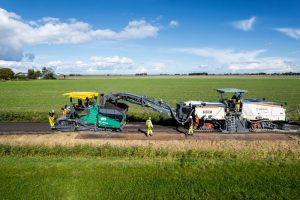
On the jobsite In Ferwert, the cold recycler milled out the old road material to a depth of 15 cm (5.9 in.) in one pass, and in the mixing chamber prepared the material to form homogeneous BSM by adding foamed bitumen using an integrated Vario spray bar. The W 240 CRi then transferred the material to the following Vögele paver, which paved the 15 cm (5.9 in.) high base course at a speed of around 4 meters (13.1 ft.) per minute. After completion of the recycling work, the SUPER 2100-5i sealed the base course with a 4 cm (1.6 in.) thick asphalt surface course.
Sustainable machine technology
The contractors relied on environmentally-friendly technologies, both for the machines used and for the rehabilitation process itself. The Vögele large paver of the new “Dash 5” generation features a particularly sustainable drive concept, for example: with a 6-cylinder John Deere engine, the SUPER 2100-5i meets European exhaust emissions standard stage 5 and still achieves 178 kW at 1700 rpm, even in ECO mode. The intelligent engine management system and Vögele EcoPlus optimized low-emissions package also reduce fuel consumption and CO₂ emissions by up to 25%. The splitter gearbox, the controlled hydraulic oil temperature circuit, the energy-optimized tamper stroke and the speed-controlled fan all contribute to the reduction.
Optimized material management and high pre-compaction
Another new feature of the “Dash 5” pavers – the updated material handling control system – was also beneficial in terms of the environmental performance and quality of the construction project. The auger and conveyors now communicate with one other, ensuring that material feed is even more consistent and precisely coordinated. This avoids load peaks, saves fuel, enables an optimum head of mix, and so uninterrupted paving. The new hydraulically extendable limiting plate for the auger tunnel, called the Power Tunnel, additionally ensured an optimum material height in front of the AB 500 TV extending screed used on the jobsite. Equipped with tamper bar and vibrator compacting systems, the screed also achieves a high degree of pre-compaction. With the hydraulic tamper stroke adjustment, the paving team was able to adjust the tamper stroke at the touch of a button from 4 mm (0.16 in.) to 8 mm (0.32 in.), optimally setting it within seconds for paving the base course and then the surface course. This significantly shortens set-up times compared to mechanical adjustment. The simple and accurate adjustment method also ensured optimum pre-compaction, good screed floating behavior, and consequently an ideal paving result.
A rehabilitation method with a bright future
After only two days, the entire 1.3 km (0.8 mile) stretch of road was completely rehabilitated. This successful test run convinced the contractors of the economic and environmental benefits of the method. The resource-saving use of material, the high quality of the prepared material, the reduced transportation required and the drop in CO₂ emissions – as well as rehabilitation in one pass – make a significant contribution to greater climate protection and efficiency in road construction. “Cold recycling technology is a model for road rehabilitation which will continue proving its efficiency in the future,” says Freesmij CEO Henk Vreeswijk.





















Partener Principal
MATEK Build Smart