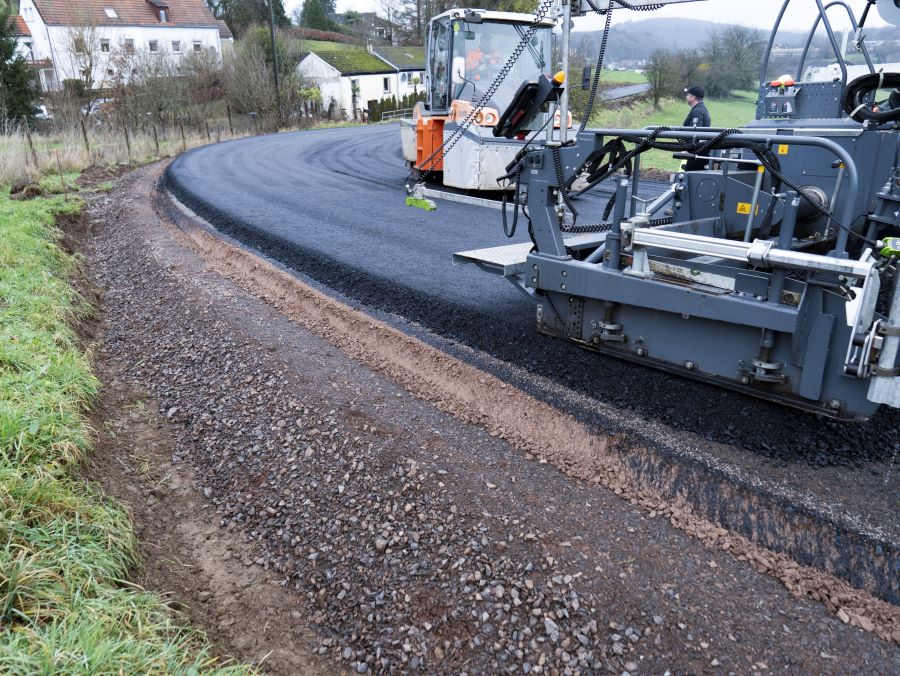
Precise, Reliable, Fast, and Resource-Friendly Paving
Automation solutions reduce the machine operator’s workload, increase efficiency, promote process reliability, and conserve valuable resources. With Grade Assist, AutoTrac and Smart Pave, Joseph Vögele AG offers three smart “helpers”: They control the paving of profiles and the direction and paving width of the Dash 5 road pavers.
Road Construction Contractors Under Pressure
Around the globe, road construction contractors are facing constantly growing challenges: the lack of skilled labor, climate change, rising prices for materials, cost and deadline pressures, high quality requirements, and mandatory verification of performance are forcing contractors to work efficiently and precisely while simultaneously conserving resources. Construction machines that integrate automation technologies are a key factor in enabling compliance with these demands. They handle routine tasks, reduce the risk of errors, and streamline workflows. Road pavers, in particular, offer enormous potential as they directly influence the paving process and the quality of the paved surface.
Smart Helpers for Asphalt Paving
Paver manufacturer Vögele therefore offers a broad spectrum of digital construction technologies: Cloud-based “jobsite intelligence” solutions such as Wirtgen Group Performance Tracker (WPT) Paving help construction contractors by means of real-time registration and analysis of relevant paving as well as paver data and optimization of the entire paving process. At the same time, Smart Automation solutions such as Grade Assist, AutoTrac, and Smart Pave assist paver operators with precise steering as well as grade and slope control. “We design our machines to build an ideal team with their operators. The pavers carry out routine or repetitive tasks and thus allow operators to focus on the actual paving and quality assurance,” says Bastian Fleischer, Head of Product Management at Vögele. In conjunction with the Dash 5 generation, Vögele has brought new solutions to the market that automate leveling tasks and the control of the paving width, direction, and positioning.
Grade Assist: Automated Profile Paving
The Grade Assist digital assistance system automates the paving of crown and cross slope profiles and expands the capabilities of the existing Auto Grade Plus system for automated grade and slope control. Operators manually set the desired profile at a target point, the slope values, and the distance until the point is reached on the screed or on the paver operator’s console. After starting the function, the automated grade and slope control system automatically regulates consistent convergence with the target values. This means that users no longer have to gradually adjust the slope up to the predefined point by hand, which avoids paving errors such as variations in the asphalt. The automated system ensures ideal transitions and an even paving result, particularly when paving with varying crown and cross slope profiles. “As Grade Assist takes control of the slope, operators are relieved of this task and can concentrate on monitoring the entered parameters and other quality-relevant factors,” says Fleischer.
AutoTrac: Automated Control Based on Physical References
If physical references such as edges, stringlines, or curbs are present, operators can also make use of the optional AutoTrac automated steering and paving width control system. It controls the paving width and travel direction of a Dash 5 paver with the aid of various sensors that scan such physical references. This solution from Vögele consists of four components that can, to some extent, be used individually or in combination: Edge Control, Steering Control, Edge Detection, and Fixed Screed Width.
The Use of a Stringline as a Reference for Automated Screed Width Control
If a stringline has been set up for regulating the height, it can also be used for automated control of the paving width. For this, the paver must be fitted with Edge Control and an ultrasonic sensor. The screed operator activates the appropriate function and the screed extension then automatically follows the stringline. Only one stringline is required for constant paving widths, as the stringless side of the screed is automatically extended or retracted. If stringlines have been set up on both sides, Edge Control can also realize varying paving widths. In the case of tracked pavers, operators can also use Steering Control and an ultrasonic sensor to automatically control the direction of travel along the stringline.
The Use of an Edge for Automated Screed Width Control
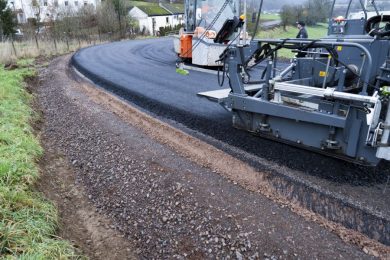
If milled edges, curbs, or gutters are used as physical references, paving crews can make use of a combination of Edge Control and Edge Detection. The LIDAR sensor (Light Detection And Ranging) scans the area in front of the end gate and identifies edges with a profile of at least 2 cm. When the screed operator activates the corresponding function, the respective screed extension automatically follows the edge. With this solution, paving crews can also equip either one or both sides of the screed with an Edge Detection sensor and thus realize constant or varying paving widths. The exact and precise control along the reference enables a perfectly fitting edge path. If the reference is available on only one side, the automated control system avoids excess widths, which, depending on the length of the paving project, considerably reduces the tonnage of mix required and cuts costs.
Smart Pave: Control based on virtual references
Smart Pave goes one step further and is the all-in-one solution from Vögele: this integrated system controls the paving width as well as the position and direction of the paver fully automatically on the basis of virtual references. The procedure is simple: The surveyor uploads the CAD model of the route to be paved to the John Deere Operations Center™, the digital construction site management system from the Wirtgen Group. There, the imported data are automatically checked for plausibility. Before starting the construction project, the operator imports the verified paving geometries via the touchscreen on the paver operator’s console. The data are transmitted to the road paver via a mobile radio link and, after activation of the project, the paver is automatically steered along the defined paving route.
The necessary hardware components are integrated on the paver. The StarFire dual antenna system from John Deere determines the exact position of the paver, the RTK modem determines the correction value for the satellite positioning data and enables high precision in the region of +/- 2.5 cm. “Smart Pave ensures particularly precise paving that prevents excess widths and thus reduces the tonnage of mix required and cuts costs,” says Fleischer. “On top of this, the solution is particularly efficient and user-friendly: Operators don’t need to install anything, data handling is simple and transparent and, thanks to automatic error analysis, leads to exactly the desired result.” The automated control system saves time-consuming position marking and increases the reliability of the paving process. It also increases user-safety: in challenging conditions such as darkness or working in tight working spaces such as in moving traffic, users enjoy a reduced workload, can work more attentively, and are more likely to stay clear of high-risk zones.
Minimal Effort, Maximum Impact
“Ultimately, we are pursuing a single goal with our automation solutions: making paving processes more precise, faster, safer, and more resource-friendly with minimal effort,” says Fleischer. Grade Assist, AutoTrac, and Smart Pave have therefore been designed as simple, scalable solutions that can be used alone or together and cater for the widely differing requirements of new road construction or rehabilitation. “They are a set of tools that reduce the workload for users on paving projects – and provide contractors with a means of leveraging higher productivity.”

























Partener Principal
MATEK Build Smart