
Rehabilitation of an Airport Runway in Jakarta
Maximum efficiency, productivity, and quality were essential factors in the rehabilitation of a 3.6 km long and 60 m wide runway at Jakarta’s Soekarno Hatta International Airport. That’s why the lead contractor decided to deploy two SUPER 1880 L pavers from Vögele.
Four Layers – „Hot to Hot”
The number of passengers and aircraft movements at the airport in Jakarta has been increasing dynamically for years, prompting continuous modernization and expansion of the infrastructure. Most recently, one of the three runways was due for rehabilitation. This task was all the more challenging given that work could only be carried out between 11 p.m. at night and 5 a.m. in the morning, when no planes were taking off or landing on the runway. Reliable and powerful machine technology was crucial for paving a length of 3.6 km and width of 60m on the runway. Two Vögele SUPER 1880 L pavers were chosen for the job. The two pavers worked alongside each other and paved four layers each “hot-to-hot” at a working width of 8.0 m – two base layers with a thickness of 7-8 cm each, an approximately 8 cm thick binder course, and a 2 cm surface layer.
Strict Quality Requirements
The paving quality requirements on this project were particularly strict. At international airports, paving requirements are based on the strict regulations of two aviation authorities, namely the International Civil Aviation Organization (ICAO) and the Federal Aviation Administration (FAA). They define a variety of parameters ranging from the mix quality and tensile strength to the surface quality and paving precision. Equally strict requirements apply to the formation of joints.
Perfectly Coordinated Paving Crews and Reliable Equipment Played a Decisive Role
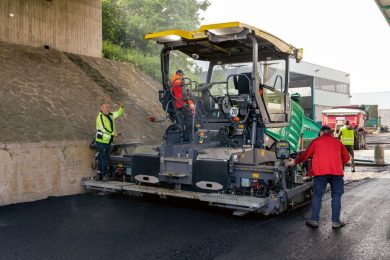
Aside from the strict quality requirements and the tight time window, care had to be taken to ensure that sufficient mix of the required quality was continuously supplied to the pavers. Airport construction sites like the one in Jakarta require experienced and well-coordinated crews and processes. This also applies to the machine technology used. For the paving work, the contractors PT Roadmixindo Raya, relied on two SUPER 1880 L pavers from Vögele. Thanks to their large material hopper, excellent laydown rate, powerful performance, and robustness, the Universal Class pavers were the ideal choice for the job. They paved together “hot to hot” in a slightly staggered formation – a paving method that ensures particularly dense and stable bonding of the individual courses and provides long-term protection against the penetration of water.
Designed to Deliver Maximum Performance
The SUPER 1880 L pavers are powered by a particularly efficient 6-cylinder diesel engine with a rated power output of 158 kW. The paver operators were able to run the engine in ECO mode during paving situations that required less power. In this mode, the nominal engine speed is reduced from 2,000 rpm to 1,700 rpm, which leads to a reduction of the operating costs and noise emission levels.
The Large Material Hopper Enables Uninterrupted Paving
Maximum productivity was also a crucial factor on the airport construction site: “To make the best use of the working hours, the processes had to run smoothly. This was the only way we could keep to the schedule,” says Tadjus Tamsil, Director at PT Roadmixindo Raya. One of the key features of the two Vögele tracked pavers, in his view, is the large material hopper with a capacity of 15 t. Its considerable length and low material feed height enabled each tipper truck to easily dock with the SUPER 1880 L and quickly offload the mix. “This meant that the trucks were able to quickly transfer their loads of mix, enabling us to maintain a high laydown rate and work continuously without interruption.” Andrew Davian, Project Manager at PT Roadmixindo Raya, adds: “The fact that the SUPER 1880 L also made it easy to meet the required criteria for surface quality and paving precision was a huge relief for the paving crew during the demanding work through the night.”
High Pre-Compaction and Surface Quality
The AB 500 TV extending screeds used on the project also played an important role in ensuring the high paving quality. The AB 500 has a basic width of 2.55 m and can be hydraulically extended to a width of 5 m. With bolt-on extensions, it enables pave widths of up to 8.5 m. “Maximum quality and perfect grade and slope control are particularly critical on a project like this at the airport. The combination of the AB 500 and the tamper bar and vibration compaction systems enable us to achieve outstanding pre-compaction and, consequently, a very high-quality result,” says David Gouw Tama Priatna, Director at PT Roadmixindo Raya. In addition, the extending screed reached the specified temperature quickly and evenly thanks to the electric screed heating system. This consistently heats all components that come into contact with the asphalt mix and ensures a particularly homogeneous surface structure.
ErgoBasic for Simple and Intuitive Operating
The intuitive ErgoBasic operating concept ensured precise paving results in Jakarta. It was developed on the basis of the proven ErgoPlus operating system from Vögele with the aim of being just as quick, precise, and intuitive – but slimmed down to the most important paving functions. Vögele has also developed a system for automated grade and slope control to complement the ErgoBasic operating system, namely Niveltronic Basic. This system is fully integrated into the machine control system and therefore tailored precisely to suit the SUPER 1880 L. ‘ErgoBasic is a major plus point of the Vögele paver. “The operating concept enables quick and simple control and makes it easier for the paving crew to achieve precise results,” says Faisol Fuad, likewise Director at PT Roadmixindo Raya.






















Partener Principal
MATEK Build Smart