
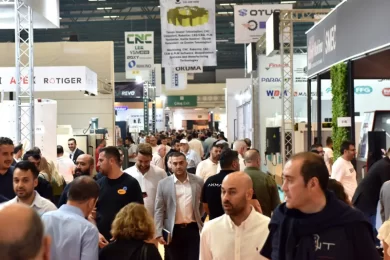
After a four-year break, BAU will open its doors again in Munich from 17 to 22 April 2023. The wire mesh manufacturer Haver & Boecker will use this get-together to present its architectural mesh solutions in the areas of facades, ceilings and walls to the industry professionals. The focus will be on the versatile application possibilities of HAVER Architectural Mesh and its positive impact on the sustainability of buildings.
Architectural Mesh the versatile all-rounder
Architectural Mesh – also known as metal mesh or wire mesh – can be used in a variety of ways in architecture. It offers architects, planners and designers extraordinary design possibilities for interior and exterior applications. Whether as a woven mesh façade, solar protection façade, wall or ceiling cladding, railing infill or as a component of acoustic systems. In new buildings and renovation projects, metal mesh impresses not only with its aesthetic and functional properties but also with its timeless elegance. Different mesh types with specific properties make HAVER Architectural Mesh a versatile all-rounder.
Architectural Mesh and its positive impact on the sustainability of buildings
HAVER Architectural Mesh is woven wire elements made of stainless steel, which consists of more than 60 % recycled stainless steel. It is corrosion resistant, easy to maintain, requires minimal maintenance and is recyclable at the end of a long service life. Thus, stainless steel mesh provides an ideal starting position on the way to sustainable building and makes a significant contribution to the positive energy balance of buildings.
Effective shading with architectural mesh
Wire mesh shows its strength in particular in facade cladding, where it can provide not only a high-quality appearance but also the desired solar protection. This is because metal mesh has an excellent shading effect, depending on the mesh type. The majority of architectural wire mesh types already achieve with a double glazing, a reduction in transmitted solar energy of between 40% and 70%. In combination with corresponding sun protection glazing, they reduce the g-value (total energy transmittance) to up to 0.1.
Top shading values: sun protection mesh LARGO-TWIST
The LARGO-TWIST 2045 solar protection mesh, developed by Haver & Boecker and awarded with the ICONIC AWARDS 2021, surpasses all previous shading values. Independent tests have shown that the mesh reduces the energy input of sunlight by more than 90% at an angle of incidence of 60°. In combination with solar control glazing, this allows a g-value of 0.02 to be achieved. However, efficient shading does not mean darkening at the same time: Thanks to the high light transmission of the metal mesh, no additional lighting is required during the day. Another plus point: Due to the mostly frontal viewing angle and the favorable light situation during the day, the wire mesh appears extremely transparent from the inside. The ideal daylight efficiency and the reduced air-conditioning and ventilation requirements have a positive effect on the energy efficiency of buildings and ensure significant energy savings.
Vertical gardens for urban greening
The climate change is the great challenge of the present time. Weather extremes such as heavy rainfall and heat waves are two of the resulting consequences. Building greening cannot solve these problems, but it can sustainably improve them in detail: This is because green facades help to dampen weather extremes through vegetation and act like a natural air conditioning system, producing moisture and oxygen and absorbing pollution from fine dust and CO2. The thermoregulating effect of façade greenery also saves costs and energy for heating and air conditioning in buildings. In addition, green facades can reduce noise pollution in cities, increase the quality of urban life, and make city districts more attractive through their external appearance.
Green facades can be implemented with HAVER Architectural Mesh. The wire mesh serves as a climbing support for climbing plants, which can grow either in ground-mounted plant containers or in plant troughs installed at specific points on the façade. The individual selection of different wire mesh types and the freely selectable arrangement of the plant troughs offer maximum design freedom.
In addition to these topics, Haver & Boecker will also be presenting numerous solutions from its proven product portfolio at BAU 2023, which trade visitors can experience first-hand at booth 211 in hall B2.
Haver & Boecker at BAU 2023: Hall B2, Booth 211











Partener Principal
MATEK Build Smart