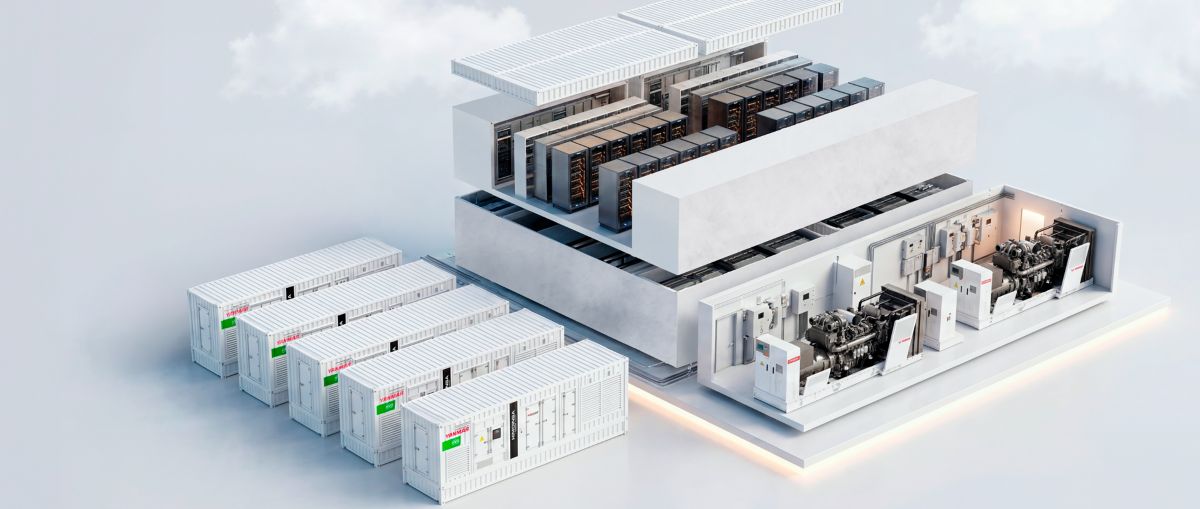
In a data centre, generator sets are an essential part of the backup infrastructure. Their role is to ensure operational continuity in the event of a power failure, but their impact extends far beyond emergency response. The way in which this equipment is sized, operated and maintained directly influences the facility’s availability, OPEX, consumables management, waste generation and environmental compliance.
Maintenance as part of the data centre strategy
In critical applications, maintenance cannot be viewed as an isolated task. It is a key tool for ensuring that the generator set performs when the system needs it, but also for protecting the investment, reducing unplanned interventions and maintaining the technical traceability of the equipment throughout its entire life cycle.
A proper maintenance programme enables work to be carried out on three complementary objectives: enhancing engine reliability, optimising operating costs and ensuring compliance with warranty and operating conditions. In this regard, oil and coolant analysis takes on particular importance, as it enables the actual condition of the fluids to be assessed and potential deviations to be anticipated before they affect the equipment’s performance.
Operating regime: the importance of correctly defining usage
The maintenance strategy must be based on the generator set’s operating regime. The ISO 8528-1:2018 standard distinguishes between different power ratings, such as ESP, LTP, PRP and DCP, each with different implications in terms of operating hours, permissible load and expected availability.
In data centres, the benchmark of 500 hours per year has become established as a ‘de facto’ standard for defining emergency use and structuring preventive maintenance. This criterion allows for a demanding operational scenario in the event of prolonged mains failures, whilst keeping in mind the usage limits and the actual needs of a critical facility.
„In DCP (Data Centre Power) applications, the generator set must be prepared to take on the critical load during a power failure, whilst maintaining high availability and controlled operation. Therefore, the correct definition of the power regime is not only a technical issue, but also a contractual, operational and environmental one”, explains Manuel Aguilera, Global Service Director.
Reliability and lifecycle of the generator set
In standby applications, where actual operating hours are usually limited, the generator set may remain on standby for long periods, but must be ready to respond immediately should a fault occur in the mains supply. For this reason, the maintenance strategy must take into account both operating hours and the natural ageing of components.
From this perspective, indicators such as MTBF (mean time between failures) and MTTR (mean time to repair) help to assess the expected performance of the equipment and to anticipate maintenance decisions. The aim is to intervene at the right time to keep the generator set within a window of maximum availability and reduce the risk of unplanned failure.
Annual preventive maintenance and technical traceability
Preventive maintenance must clearly distinguish between visual inspections, periodic tasks and the physical replacement of consumables. Daily or weekly checks allow for the verification of levels, the condition of the control panel, possible leaks, general cleanliness and the visible condition of the equipment. They are essential for the early detection of anomalies.
Annual maintenance involves work on the generator set’s main systems: lubrication, fuel, intake, cooling and alternator. This includes changing oil and filters, checking fuel system components, inspecting the cooling system, examining connections and wiring, and lubricating components where necessary.
In mission-critical applications, this approach must be accompanied by proper documentary traceability. The use of genuine spare parts, adherence to the maintenance schedule, and the analysis of oil and coolant are key elements in maintaining the warranty and demonstrating that the equipment remains within the parameters defined by the manufacturer.
OPEX and maintenance based on the current condition of the equipment
One of the key points regarding standby installations is that actual operating hours are usually limited. In such cases, the condition of the oil depends on several factors: operating hours, time, storage conditions and the actual deterioration of the fluid.
For this reason, HIMOINSA proposes an analysis-based approach. Regular sampling allows the condition of the lubricant to be assessed and replacement intervals to be adjusted more precisely. This approach enables a shift from maintenance based solely on a fixed schedule to a data-driven strategy. The result is more efficient OPEX management and operation better tailored to the generator set’s actual usage profile.
In continuous-duty applications, the logic is different. Here, the determining factor is not so much time as operating hours and the degree to which the oil is saturated by use. In such cases, solutions such as enlarged sump tanks or bypass centrifugal filter systems can help to extend the intervals between physical interventions, always in accordance with the technical specifications of each engine and application.
Waste and environmental compliance
In large data centres, the management of consumables can have a significant impact. Replacing oil in multiple generator sets can generate substantial volumes of hazardous waste, entailing additional obligations regarding record-keeping, traceability, waste minimisation plans and reporting to the authorities.
Therefore, reducing unnecessary oil changes through oil analysis not only helps to optimise costs; it also helps to limit waste generation and strengthen the facility’s environmental strategy. In projects where AAI plays a decisive role, such decisions provide technical and documentary value.
A representative example illustrates this point: an annual volume of 15 m³ of used oil, with an average density of 880 kg/m³, amounts to approximately 13.2 tonnes of hazardous waste. This figure exceeds the threshold of 10 tonnes per year, above which specific obligations apply to the producer of hazardous waste.
Load testing and environmental performance
The way in which generator sets are tested also influences environmental compliance. Testing under no-load or very low-load conditions can have a negative impact on both the engine and the quality of combustion. In contrast, testing under real-load conditions allows for more stable thermal conditions, improves combustion and promotes more effective dispersion of exhaust gases.
In this regard, phased planning of testing and maintenance helps to avoid unnecessary simultaneous start-ups and reduce emission peaks. The operation of the generator set thus becomes an active part of the data centre’s environmental strategy.
Fuels, emissions and technological alternatives
Fuel selection is also part of the overall strategy. HVO100 can help to significantly reduce net CO₂ emissions and offers advantages in standby applications due to its stability during prolonged storage periods. However, its use must be analysed taking into account runtime, availability, cost and specific project requirements.
Furthermore, where regulatory frameworks require it, after-treatment systems such as DOC, DPF or SCR can be integrated to reduce specific pollutants. These technologies enable the solution to be adapted to projects with more stringent environmental requirements, whilst maintaining the necessary availability for mission-critical applications.
A comprehensive approach to critical infrastructure
In a data centre, availability does not depend solely on installed power capacity. It depends on a comprehensive strategy that takes into account operating procedures, preventive maintenance, fluid analysis, waste management, load testing, fuel selection and the technical documentation required to demonstrate environmental compliance.
This approach enables reliability, operational efficiency and AAI to be aligned from the design phase right through to day-to-day operations. For HIMOINSA, this approach represents a way of supporting clients, engineering firms and operators on projects where service continuity and technical compliance are inseparable requirements.
About HIMOINSA
Founded in 1982, HIMOINSA is a leading designer and manufacturer of power technology solutions. It supplies power generation equipment in the international market: generator sets, lighting towers, and power storage and distribution systems.
From mission-critical to backup and continuous power, HIMOINSA provides complete, reliable and efficient diesel and gas power generation solutions wherever reliability is needed. With thousands of installations worldwide and different applications and sectors such as healthcare, hotels, data centres, manufacturing, mining, construction and independent power plants, the company has delivered power solutions for the international market during the last 4 decades ensuring cutting-edge technology, high performance, lower NOx, the most efficient systems and simplified maintenance.
In 2015, HIMOINSA became part of the Yanmar Group (Japan, 1912), a renowned company in the international market, a leader in the design and manufacture of industrial and marine engines, agricultural and construction equipment, etc.
About YANMAR
With beginnings in Osaka, Japan, in 1912, Yanmar was the first ever to succeed in making a compact diesel engine of a practical size in 1933. A pioneer in diesel engine technology, Yanmar is a global innovator in a wide range of industrial equipment, from small and large engines, agricultural machinery and facilities, construction equipment, energy systems, marine, to machine tools, and components — Yanmar’s global business operations span seven domains.
On land, at sea, and in the city, Yanmar provides advanced solutions to the challenges customers face, towards realizing A Sustainable Future. For more details, please visit the official website of Yanmar Holdings Co., Ltd.



















Partener Principal
MATEK Build Smart