
Spokesperson: Ian De Dobbelaere, Commercial Project Manager at Komatsu Smart Construction
Over the last decade, the construction and earthmoving sectors have made major strides in adopting and deploying intelligent machines, yet many sites still operate with limited information.
The result? An industry trying to push machines toward higher autonomy, while overall project management and day-to-day operations continue to be reactive.
The gap between machine capability and site readiness is now a critical barrier to progress. Ian De Dobbelaere, Commercial Project Manager at Komatsu Smart Construction, discusses how digital tools and material tracking can transform reactive operations towards proactive, data-driven leadership.
The onsite shift to proactive operations
Construction sites are dynamic and ever changing – terrain shifts daily, material placement fluctuates and unexpected obstacles are the norm. Machines equipped with on onboard sensors, cameras, LiDAR and proximity detection are still fundamentally reactive.
Limited to only respond to what is directly in front of them, not to the wider context of the job. On a construction site that shifts daily, reactive autonomy can avoid collisions but it cannot anticipate production risks, optimise a haul sequence or adapt to design changes happening 300 metres away.
This leaves even the most advanced equipment operating in a narrow silo of awareness, unable to contribute to site-wide optimisation.
Shifting from reactive to proactive construction involves moving away from fixing problems once they occur to predicting and preventing them. Proactivity relies on data, planning and risk management to improve efficiency, reduce costs and minimise delays.
A real-time picture of the site
Proactive operations require a full picture of material movement, progress and evolving site conditions. Historically, this level of insight has not been possible. Surveys were periodic and disruptive, sporadic drone flights produced snapshots rather than continuity and reporting depended heavily on manual updates.
By the time information reached decision-makers, the ground had already changed.
One of the biggest challenges in moving from reactive to proactive construction has always been accurate data. The breakthrough comes from reframing how we see heavy machinery not just as tools that move earth – but as sensors that map it.
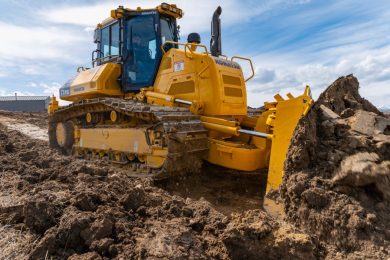
Modern dozers and excavators are already able to track their position to the sub centimetre – monitoring the movement of blades and buckets effectively turns them into high-frequency data collectors, generating as-built information naturally as they work.
This machine as a sensor approach is already delivering tangible results. On a recent project with HEITKAMP Corporate Group, machinery captured high-density as-built data of compacted soil, creating a reliable record that will serve as the project’s reference for years.
Building the digital twin
The use of digital twins is revolutionising construction and earthmoving sites by providing a continuous up-to-date representation of a job site. The data mapping within a digital twin process can also be utilised by wider systems to help optimise resource allocation.
By simulating different scenarios, such as fleet compositions or the sequence of project milestones, automation can assist project managers to make data-driven decisions, informing machinery deployment and labour more efficiently, boosting productivity and allowing workers to focus on other tasks.
Closing the loop
Proactive construction relies on a continuous cycle of measurement, analysis and execution. As machines work, they capture real-time data from the site, creating a constantly updated picture of progress and conditions.
Planning tools and AI then analyse this information, simulating scenarios, resolving potential delays and optimising the use of equipment and resources. Decisions and instructions are automatically fed back to the machines, ensuring that operations remain on track without manual intervention.
Material tracking plays a central role in this cycle, acting as the bridge between today’s connected job sites and tomorrow’s autonomous operations. By integrating GPS-enabled machinery, onboard sensors, and 3D model data, digital tools capture precise, real-time information on material flow.
This continuous stream of data feeds into digital twin technology, giving teams full visibility and creating a real-time feedback loop that connects machines, the site environment, and planning teams.
The result is a truly proactive, data-driven construction site, where equipment and personnel operate in harmony, decisions are informed before problems arise, and operations become safer, more efficient, and ready for the next generation of autonomous capabilities.
Looking ahead
The future of earthmoving and construction lies in autonomous intelligence driven by real-time material tracking. Closing the gap between machine intelligence and site intelligence is the next major adoption for the sector.
As this technology advances, the digital twin evolves into a predictive control center allowing project managers and equipment operators to optimise the construction site.
The shift from reactive to proactive construction is no longer optional – it is essential for driving productivity, reducing costs and delivering projects with confidence and precision.
For more information about how digital technology can enable decision making, visit: smartconstruction.io
Issued on behalf of Smart Construction by Lucky North.
About Smart Construction
Smart Construction is a digital transformation strategy created by Komatsu together with Sony Semiconductors, NTT Communication and Nomura Research Institute under the entity EARTHBRAIN Limited. These four organisations are known for their significant contributions to delivering the greatest innovation leaps to their industries.
Smart Construction experts utilise digital tools to assist clients in the earthmoving and quarry industries by finding the optimum way of using resources like machine, material and people for enhanced productivity, quicker project completion, cost savings, improved safety, and reduced CO² emissions.
Smart Construction’s comprehensive range of solutions and services are fully accessible in Germany, France, the United Kingdom, Denmark, the Czech Republic, Austria, and Slovakia. Smart Construction 3D Machine Guidance is available in most European regions.





















Partener Principal
MATEK Build Smart