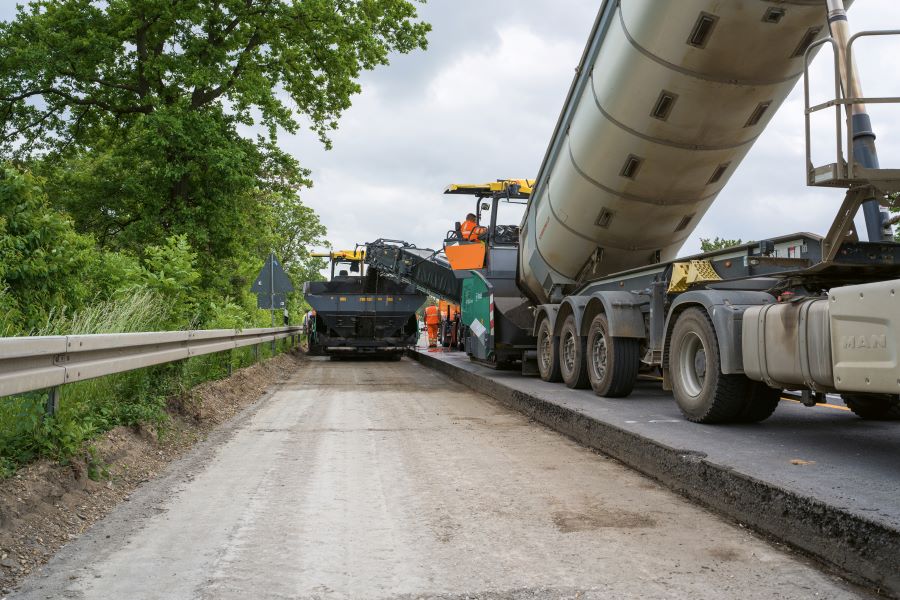
Sustainable Full Rehabilitation on the A 555 near Cologne – Significant Reduction of CO2 Emissions
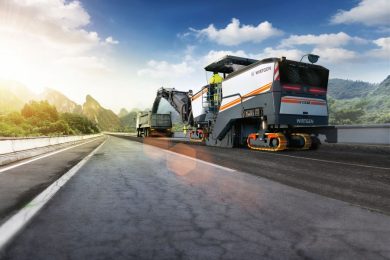
A full rehabilitation of a 2.5 km section in both directions was carried out on the A 555, Germany’s oldest Autobahn. The overall construction time was estimated at over 18 months. The lead contractor on the project chose to use the cold recycling method from Wirtgen as an alternative to conventional construction methods.
At least two lanes were to be kept open to traffic to avoid serious traffic congestion in the region. The hard shoulder was reconstructed as a heavy vehicle lane with the highest load class of BK100. With conventional paving methods, this would have meant milling off, removing, and disposing of all asphalt layers, stabilization of the sub-base, reconstruction of the asphalt base layer and asphalt binder course, and the paving of an asphalt surface layer with the required load bearing capacity.
A Resource-Friendly Alternative
In conventional asphalt construction, the main sources of CO2 emissions are the production of the new asphalt layers and the transportation of material to and from the construction site by trucks. As here on the A555, the cold recycling method from Wirtgen offers emission reduction potentials by paving the new base layer with bitumen-stabilized material (BSM) continuously produced at a rate of 240 t of cold mix per hour in a mobile cold mixing plant KMA 240i. Thanks to its high mobility and relatively small footprint, it was also possible to set up the plant at a close and logistically favorable distance from the construction site. This enabled the reduction of a large proportion of the emissions resulting from material transport. “What Wirtgen is offering us here with its cold in-plant recycling method is an exceptionally advanced process,” said Stephan Ehlers, Technical Manager, STRABAG AG (Düren Region).
The cold mixing plant KMA 240i produced the mix for the BSM base layer from reclaimed milled asphalt with the addition of foamed bitumen and cement. The most significant reduction of CO2 emissions achieved here was a result of the cold processing of the mix. Alone the bitumen was delivered at a temperature of 180°C and then processed together with water and air to produce foamed bitumen. All this eliminated the need for energy-intensive heating of the aggregate fractions or the granulated asphalt.
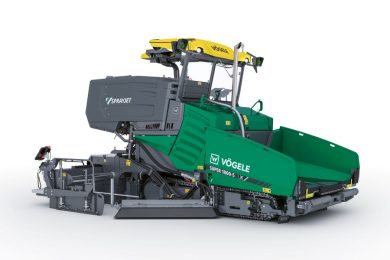
In order to achieve the specified degree of compaction, the BSM base layer was paved over the pre-prepared sub-base in two separate layers. To ensure uninterrupted paving, a Vögele MT 3000-3i PowerFeeder successively conveyed the mix to the Super 1900-3i paver following on behind. This then took care of the true to grade and slope paving of the new base layer to a working width of 3.6 m. The first layer of cold mix paved had a thickness of 16 cm and the second layer, paved the next day, a thickness of 10 cm. Following pre-compaction with the AB500 screed, each of the cold mix layers was ideally compacted by an HD+ 140 tandem roller and an HP 280i pneumatic-tire roller from Hamm. On the construction site, the material fulfilled all the requirements previously determined by preliminary testing. As the final step in the process, the BSM mix was overpaved with a new asphalt surface layer (SMA 11 S) with a thickness of 4 cm.
BSM – A Low-Cost, High-Quality Construction Material
BSM mix is firmly established in many countries and is used for all load classes. Using BSM for the base layer on major roads and highways is also nothing new around the world and is becoming increasingly interesting and popular in Germany. Suitability testing of the cold recycling mix for the new base layer on the A 555 near Cologne was carried out by STRABAG AG (Düren Region) with the assistance of Wirtgen in its own construction materials testing lab. When appropriately formulated, the mix is suitable for all traffic loads. The quantities of binding agent and aggregates to be added were determined in preliminary trials. Reclaimed asphalt pavement with 25% crushed sand for the filling of fines, plus 1% cement, 2% foamed bitumen, and water yielded positive synergies for the sustainable mix.
As BSM mix can be stockpiled, it also enables more flexible site logistics. This means that mix can be produced at any time and placed in temporary storage until required. The mix remains pavable and, in contrast to conventional mixes, does not need to be laid down within an extremely short space of time.
“We can make process flows considerably more effective and faster with bitumen-stabilized material. In view of our expressed commitment to achieving climate neutrality by 2040, we have a vested interest in the further development of what we have learned from this project,” emphasized Stephan Ehlers
The Advantages of Cold Recycling at a Glance
Up to:
- 100% lower costs for material disposal
- 90% less transport volume
- 90% lower consumption of resources
- 60% lower CO2 emissions
- 50% reduction of binding agents required
- 50% lower overall costs
- 50% shorter construction time
Project Details:
Length of the reference section: 500 m (section of hard shoulder)
Paving width: 3.6 m
Thickness of the BSM layer: 26 cm
Thickness of the surface layer: 4 cm
Performance Data KMA 240i: 1,250 t of material produced in 5 hours















Partener Principal
MATEK Build Smart