Lectures via video streaming, online seminars, and a digital panel discussion
Carbon textile-reinforced concrete is a composite of high-performance materials that is corrosion-resistant, thin, light, resource-friendly and environmentally friendly. It provides a basis for long-term endurance in construction, both in new buildings and in renovation or repair. Longevity and economic viability are two essential factors at which the construction industry as well as research, politics and environmental associations have demonstrated a keen interest.
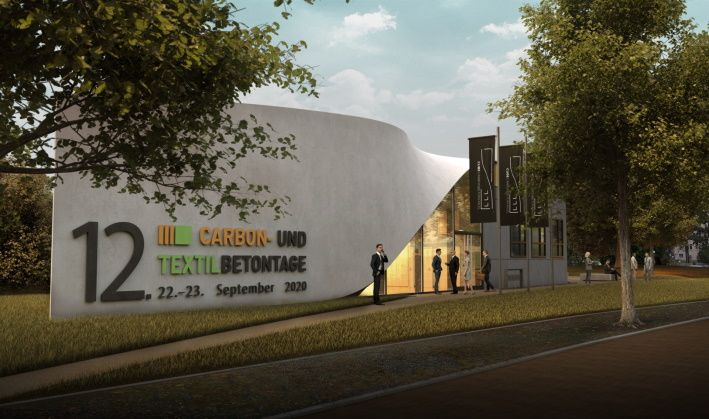
Every year, the Carbon Textile-Concrete Days present the latest developments, findings and insights in industry and science. This year’s 12th Annual Carbon Textile-Concrete Days (22nd and 23rd of September) will take place in a digital format and with a special highlight: The virtual stage of the digital premiere is the world’s first carbon-concrete house, the so-called CUBE in Dresden. The experimental building, which is due to be completed in mid-2021, invites visitors to discover the exhibition hall on a virtual tour of the building complex.
The digital and international conference on the 22nd and 23rd of September will offer lectures via video streaming and online seminars, chats with speakers and a live digital panel discussion, each in German and English. Afterwards, recordings and contributions from the two-day conference will be available to view for up to 10 days. The conference is organised by the C³ – Carbon Concrete Composite Project – funded by the Federal Ministry of Education and Research and the TUDALIT Registered Association.
The conference’s target audience are architects, designers, engineers, construction companies, component and system suppliers, investors, manufacturers of reinforcement systems or pre-cast concrete parts with textile reinforcement, as well as all persons interested in carbon and textile concrete from the sectors of economy, industry, science, politics, and administration.
Over the course of 24 lectures, 3 online seminars and a live-broadcast panel discussion, diverse information, compact knowledge, up-to-date results, and application examples from practice and research on carbon and textile concrete will be covered, including current topics in renovation, new construction, components, reinforcement, and calculation. The focus will be on an effective exchange of results and experiences between national and international speakers and participants, as well as the dissemination of knowledge gained from attendees’ current projects. This provides an optimal platform for expanding personal networks for future cooperation.
For more information, see the current agenda and the link to the online registration at www.carbon-textilbetontage.de or www.carbon-textilbetontage.de/en/home/
Insight into the Program
Carbon and textile concrete can be used in a variety of applications. Textile concrete has great trend-setting potential, for example, in the renovation and reinforcement of bridges. This said, the application of carbon concrete goes far beyond the repair and construction of bridges or buildings. It opens up extensive possibilities for a completely new type of building and living environment, creating an economical, resource-saving, and sustainable alternative benefiting the entire construction industry. Below are some insights into the topics that will be covered during the conference agenda:
Mr Oliver Steinbock from Curbach Bösche Ingenieurpartner will present on carbon concrete reinforcement on a reinforced concrete bridge within a federal highway. The construction project will be implemented during 2020, allowing for design, planning and implementation aspects will be explained in the presentation. These are two partial structures, each with three fields and a total length of about 66 m. In order to ensure an accurate assessment of the collapse behaviour when facing tension-crack corrosion, the bearing structures are reinforced with carbon concrete across large surfaces in the peripheral fields and in the supporting area.
Several bridge building projects where textile or carbon concrete was used will be presented in lectures at the conference. These include, among others: Planning procedures for strengthening bridges by means of textile concrete in a pilot project in Austria (M. Egger, University of Innsbruck); Carbon concrete for reconstruction of Rosensteinsteig II in Stuttgart (Martin Rettinger, Technical University of Berlin); Ecological balance of a bridge in Ebingen (Sergei Rempel, Solidian GmbH); The first street bridge with pure carbon-fibre reinforcement (Rainer Wursthorn, RS Ingenieure GmbH); Carbon concrete in bridge construction – Current approvals for individual cases of strengthening and new buildings (Sebastian May, Alexander Schumann, CARBOCON GmbH); Pre-stressing as a means of economical and resource-saving construction with carbon concrete (Frank Jesse, Hentschke Bau GmbH).
Mohit Raina, Raina Industries Private Limited Mumbai, India, will speak about fibre- and textile-based concrete reinforcement for applications in tropical climates. In conventional steel concrete reinforcement, preventing corrosion is one of the biggest challenges. The problem of reinforcement is particularly pronounced in countries with high humidity, such as India. To solve this problem, fibres and textile-based reinforcement are used. Currently, these reinforcement systems are used for non-structural and semi-structural components. In India, fibres and textiles are used as reinforcement materials in very decorative architectural facades as well as street furniture and toilets. Fibres and textile reinforcement allow for very thin-walled structures and lightweight components, which resist damage during transportation. The required amount of fibre and textile layers is determined in the course of iterative tests or in co-operation with the fibre manufacturer. Virgin AR glass fibres and carbon fibre trims are used as reinforcement. In certain applications, profiled polypropylene fibres are used. C-fibre mats are used for cladding on concrete columns as a type of structural component. Other applications in the range of structural components are currently being investigated.
Innovative carbon-concrete hoods for thermal conduction ducts are the subject of the presentation by Mr. Jan Kortmann, from the Technical University of Dresden. For the district heating transfer, duct-routed pipes are used, among other things. These long-distance heat lines are covered with duct hoods consisting of ready-to-use reinforced concrete components along the entire route. This facilitates maintenance and servicing. In the city of Dresden alone, there are 500 km of this type of canal line. Due to permanent contact with the ground, the previous duct hoods are at risk of corroding; thus, corrosion is the main problem of using steel reinforcement in addition to changes in the usage above ground level. In the event of an accident caused by broken-in duct hoods, the user may incur high costs because of infrastructure disruption and necessary refurbishment. Currently, existing duct hoods are being successively replaced by new reinforced concrete hoods. However, despite these very massive hoods, the basic problem of corrosion still exists. In a feasibility study, it was investigated to what extend the carbon concrete can be used in the existing duct-hood structures. With the newly developed carbon-concrete duct hood, approximately 50% of the component mass could be saved and the static load-bearing effect would remain the same. In addition, the monetary advantage of using carbon concrete construction can be proven by comparing cost effectiveness. The first use is currently planned for 60 km of the canal line in Dresden.
In one of the three online seminars, Professor Josef Kurath from the University of Applied Sciences of Zurich (ZHAW), Department for Architecture, Fibre-composite Materials will speak about measuring CPC carbon concrete slab components. In the last three years, a very detailed and extensive trial program was conducted to obtain a general approval for the use of CPC carbon concrete slabs in Germany, wherein design models were also defined. Based on the requested approval of the CPC carbon concrete slabs by the DIBt institute in Germany, the design models are explained, with which a civil engineer can calculate and use CPC carbon concrete slabs for load-bearing structures. In this case, erected buildings or manufactured components are used as references.
For more information, see the current agenda and the link to the online registration at www.carbon-textilbetontage.de or www.carbon-textilbetontage.de/en/home/















Partener Principal
MATEK Build Smart