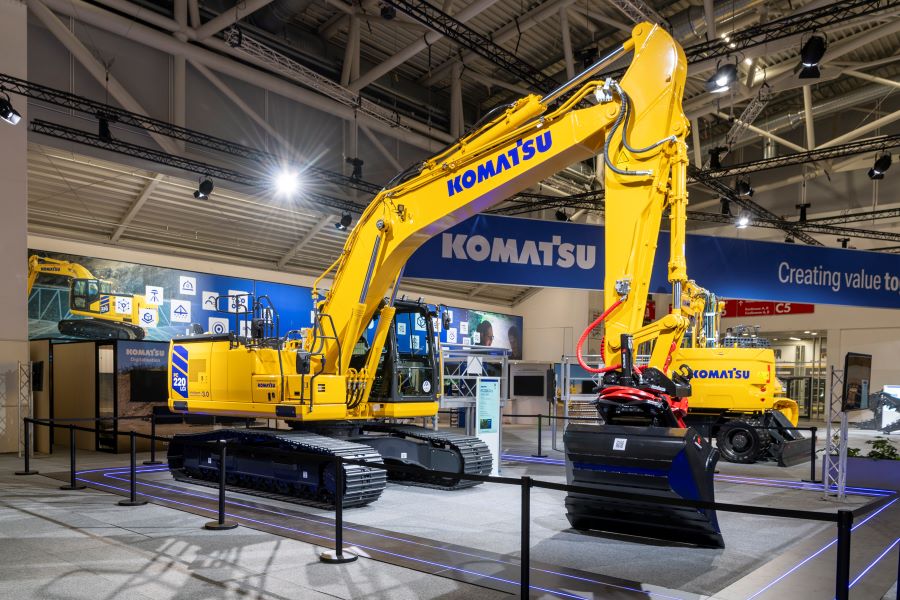
Looking back at 2025, one trend dominated the heavy construction equipment industry – the rise of autonomous machines. Over the past year, major industry fairs have highlighted leading manufacturers are advancing autonomous equipment, signaling a significant shift in site operations.
While fully autonomous machines are not yet a reality, progress is being made to tackle common challenges and barriers – drawing insight from industrial sectors and considering automation across the construction site as a whole.
Below, Komatsu Smart Construction experts provide insight into the most significant digital and technological changes shaping the industry in 2026 and how ‘smart’ construction sites are integral to this next phase of autonomy.
The challenge
Despite advances in machine autonomy, construction sites themselves are often not yet considered in a connected, holistic way. Decisions on-site remain largely reactive because machine data is often trapped within individual controllers or brand specific platforms.
To advance true autonomy, this data must be aggregated into a central, independent digital model that works across machines, brands and levels of autonomy.
Digital twins are central to this transformation, providing a continuously updated ‘hive mind’ that combines detailed visual representations of the job site with real-time machine data. Integrating digital twins with AI, drones, robotics and advanced analytics empowers smarter decision-making, increases productivity and reduces risk.
Introducing the 5×5 framework
The path to the digitalisation of the industry is visualised not as a single ladder but as a graph with two axes – the 5×5 framework. This framework helps explain why some sites are ready for advanced machinery while others are not.
-
X-Axis: Measures the level of autonomous operation of machines, from level 1 (assistance) to level 5 (full autonomous decision-making).
-
Y-Axis: Measures the optimisation of the construction site, from level 1 (basic 3D design data) to level 5 (fully optimised, automated construction planning).
The key takeaway of the 5×5 framework is that technology alone is not enough, while many machines are highly advanced, they are often deployed on sites that have low process maturity.
Taking inspiration from the mining industry
The mining sector has demonstrated the potential of autonomy and in 2026, the construction should draw down learnings from this type of approach. Underground operations have shown that autonomy works best when machines aren’t acting in isolation, but as part of a connected, site-wide ecosystem.
Mining professionals actively apply the 5×5 framework, balancing machine autonomy with site-wide process optimisation to achieve maximum efficiency and safety. Future construction sites should adopt site-wide, connected ‘ecosystems’ – where machines operate cohesively, rather than in isolation.
A focus on site
Beyond the technology itself, industry leaders emphasise the importance of site-level awareness. To achieve true site-wide autonomy, construction companies must advance both axes simultaneously, intelligent machines and optimised, data-driven construction processes.
Successful autonomy depends not just on the machines but on a holistic understanding of the construction environment. Integrating digital twins with advanced analytics, drones, AI and robotics creates a framework that improves decision-making, increases productivity and reduces risk.
Looking forward into 2026, the next step for the European construction industry is adopting a common digital twin model across the sector. While this is a relatively small technical step, it represents a major cultural shift and contractors must first become accustomed to using digital twins for analysis.
The 5×5 framework provides a clear roadmap, advancing both the machine and the process together is the key to unlocking the next era of construction efficiency, safety and cost management.
For more information please visit: smartconstruction.io.
About Smart Construction
Smart Construction is a digital transformation strategy created by Komatsu together with Sony Semiconductors, NTT Communication and Nomura Research Institute under the entity EARTHBRAIN Limited. These four organisations are known for their significant contributions to delivering the greatest innovation leaps to their industries.
Smart Construction experts utilise digital tools to assist clients in the earthmoving and quarry industries by finding the optimum way of using resources like machine, material and people for enhanced productivity, quicker project completion, cost savings, improved safety, and reduced CO² emissions.
Smart Construction’s comprehensive range of solutions and services are fully accessible in Germany, France, the United Kingdom, Denmark, the Czech Republic, Austria, and Slovakia. Smart Construction 3D Machine Guidance is available in most European regions.

























Partener Principal
MATEK Build Smart