
Benninghoven offers a broad spectrum of groundbreaking technologies that drive sustainability in the asphalt industry and simultaneously secure the future economic viability of businesses. First and foremost among these is the world’s first burner that can be fueled using 100% green hydrogen. This technology has now been evaluated in the field for the first time in Norway.
Our example shows how construction company Veidekke Industri AS, is pioneering the use of hydrogen as a fuel in asphalt production. “We see social and ecological change as an opportunity for making the most of our innovative corporate culture and engineering expertise. Hydrogen burners from Benninghoven are a great help to us in this,” says Eddie Heggard Engebretsen, Senior Project Manager at Veidekke.
The Use of Hydrogen Technologies Leads to a Flexible End-to-End Solution
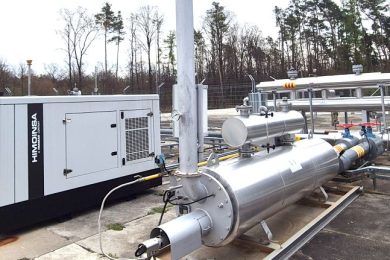
Benninghoven has developed a coordinated, end-to-end solution for material drying. For the first time, this makes it possible for users to utilize up to 100% green hydrogen in the production process. The hydrogen-fueled drying system consists of a MULTI JET burner, a burner control system, a feed system with a patented pressure control section that reduces the hydrogen pressure to the required value for burner operation, and other plant components specifically adapted to operation with hydrogen. This end-to-end solution connects directly to the hydrogen source, flexibly incorporating various sources such as trailers, supply networks, or decentralized electrolyzers.
A safety plan is essential when using hydrogen. This was prepared by the specialists from Benninghoven in close collaboration with the Norwegian company. In addition to the reduction of CO2 emissions, it is also crucial to monitor NOx emissions. The Benninghoven system includes exhaust gas recirculation, which keeps NOx emissions low.
With the hydrogen burner system, the manufacturer and specialist for asphalt mixing plants provides a mature, practical solution that offers not only technical but also economic advantages. The ability to switch flexibly between energy sources allows operators to react to market conditions and changing carbon tax rates. The resulting reductions of operating costs play an important role in assuring the operator’s future economic viability.
First Successes in Norway – Our Customer Wins 2024 Climate Award
“In the past, we assessed where we could reduce CO₂ emissions in our processes as quickly as possible. For asphalt paving itself, we came to the conclusion that we’d currently be able to achieve reductions of only 3% – but things look very different when it comes to asphalt production. Here, our use of hydrogen already enables us to reduce our CO2 emissions by as much as 40%.” explains Heggard Engebretsen.
Veidekke has been evaluating the technology at its site in Kristiansund since 2023. In the meantime, several thousand tons of asphalt have already been produced with hydrogen.
A second plant in Ålesund has also been running since 2024. The aim here was to validate the process and verify whether a reliable result could be achieved under changed process conditions. This step was crucial for achieving production maturity. In the same year, Veidekke was honored with the 2024 Climate Award for its work on hydrogen-produced asphalt in Norway. Veidekke is already planning to begin production at its next hydrogen-fueled plant in 2025. “We consider Benninghoven to be an extremely competent partner for our mission. Since the commissioning of the MULTI JET burner, we’ve already produced several thousand tons of asphalt using only hydrogen as a zero-emission energy source,” says Heggard Engebretsen.
Hydrogen – Potential, Challenges, and Outlook
The utilization of green hydrogen enables an enormous reduction of carbon emissions in asphalt production. According to latest estimates, around 45% of the carbon emissions in the road construction process chain are generated by asphalt mixing plants, whereby 41% are generated solely by the burner. In view of this, the use of a hydrogen burner is the most effective tool available for the minimization of carbon emissions.
“Here in the far north, there’s a lot of green energy being generated by hydroelectric power plants. Overall, we must unfortunately say that despite the enormous potential, availability is currently still lagging behind demand. In my view, it can only be a question of time before this is understood and will be appropriately promoted and subsidized.” says Heggard Engebretsen.
A Retrofit Is Possible at Any Time
The burner technologies can be installed or retrofitted in new-build and existing asphalt mixing plants from Benninghoven and other manufacturers. The MULTI JET burner can use up to four different fuels at the same time, regardless of their physical state – whether solid, liquid, or gaseous. Other features are mixed combustion and fuel-switching on the fly – all without having to shut down the plant or disrupt the production process. Plant operators therefore enjoy a high level of flexibility in the choice of the most economically-priced and readily available energy sources. Furthermore, the ability to simply convert plants to the latest burner technologies at any time is an important factor for achieving cost-efficient and sustainable asphalt production as well as securing the long-term viability of production sites.






























Partener Principal
MATEK Build Smart